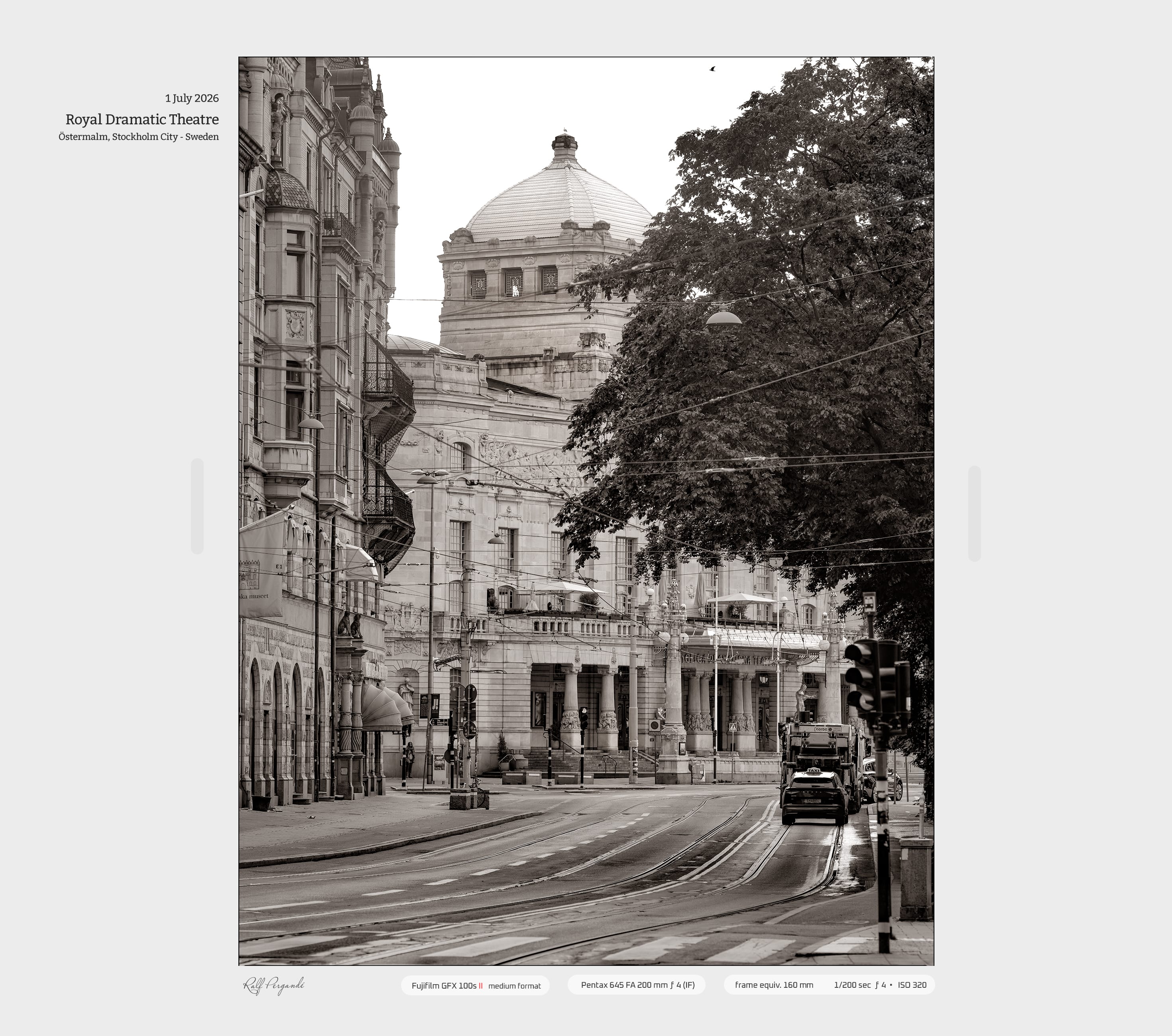
In hindsight, despite my (partial) criticism about the Pentax 645 FA 200/4 (IF) lens - it is still a charming lens. Especially at infinity, given that it renders sharp images.
Even when i use it at wide open aperture ƒ4 - which is a bit softer by a notch - the above image, was actually not in focus of the Theatre building. Yet, given that this is a downsized 4 MP diary photo from 102 MP, it looks razor sharp !
Reminds me a little bit of that when you worked with large film negatives - but the final photo wasn't really that large - things just looked wonderful and sharp anyway. And noise free / grain free.
So, even if a lens isn't top-notch and everything - you get a long way with good lenses that ain't perfect according to today's digital "standards". I mean, in the digital world of today, with insane high resolution sensors - you see every fart, every tiny flaw...
Perhaps, or almost, like not seeing the forest because of all the trees.
So, yes - the Little, light, charming and extremely affordable Pentax 645 FA 200/4 (IF) lens, is actually a good work horse, especially for objects that are further away and at infinity. Stop the lens down, and it gets razor sharp.
Not bad for a true mediumformat lens from the 90s
adapted to a Fujifilm GFX 100s II camera, via the Fringer P645-GFX electronic adapter, which ensures you working AF, full EXIF data and image stabilization (via the camera) activation in the most easiest way.
I may not be in love with this lens - but i find it's rather small size, combined with the light weight to be really charming to work with. Naturally, everything is relative. Working with mediumformat cameras and lenses often means big, heavy and bulky. If you come from a small camera - everything is suddenly huge and heavy. (think Fujinon GF 110mm ƒ2 for example).
Therefore, in my world the impression of the Pentax 645 FA 200mm lens is the opposite; rather cute, light and easy to handle. Easy for a daylight walk-around lens.
And if i have not mentioned it, the focal length equals to a 160 mm lens when adapted to a Fujifilm GFX camera. Kind of like a moderate telephoto lens, in other words.
Again to point out
that i believe this lens is in particularly nice when you do Black & White photography. I like the rendering in general much better in B&W, and you bypass chromatic aberrations & LoCA for example, since those are not visible in black & white.
I mean, as with almost all vintage film era lenses - they exhibit more or less such optical errors, since they are were not corrected for digital sensors. Some are better than others. They are mainly visible at wide open aperture. Worth to remember; the more you stop the aperture down, the more those disappear. |