Entering August
As we go deeper into the month of August, you can tell that the bright nights are over (during midnight, around 00.50 local time when the sun is at its lowest point below the horizon). And soon we approach the Perseiids meteor showers around 11-12 August, which also marks the point where the (short) nights are in the astronomical twilight, on the verge of almost reaching astronomical night. The latter marks the suns position -18 degrees below horizon. (I don't know the exact date when the sun reaches -18°, though).
Stockholm Solar Eclipse weather (12 Aug)
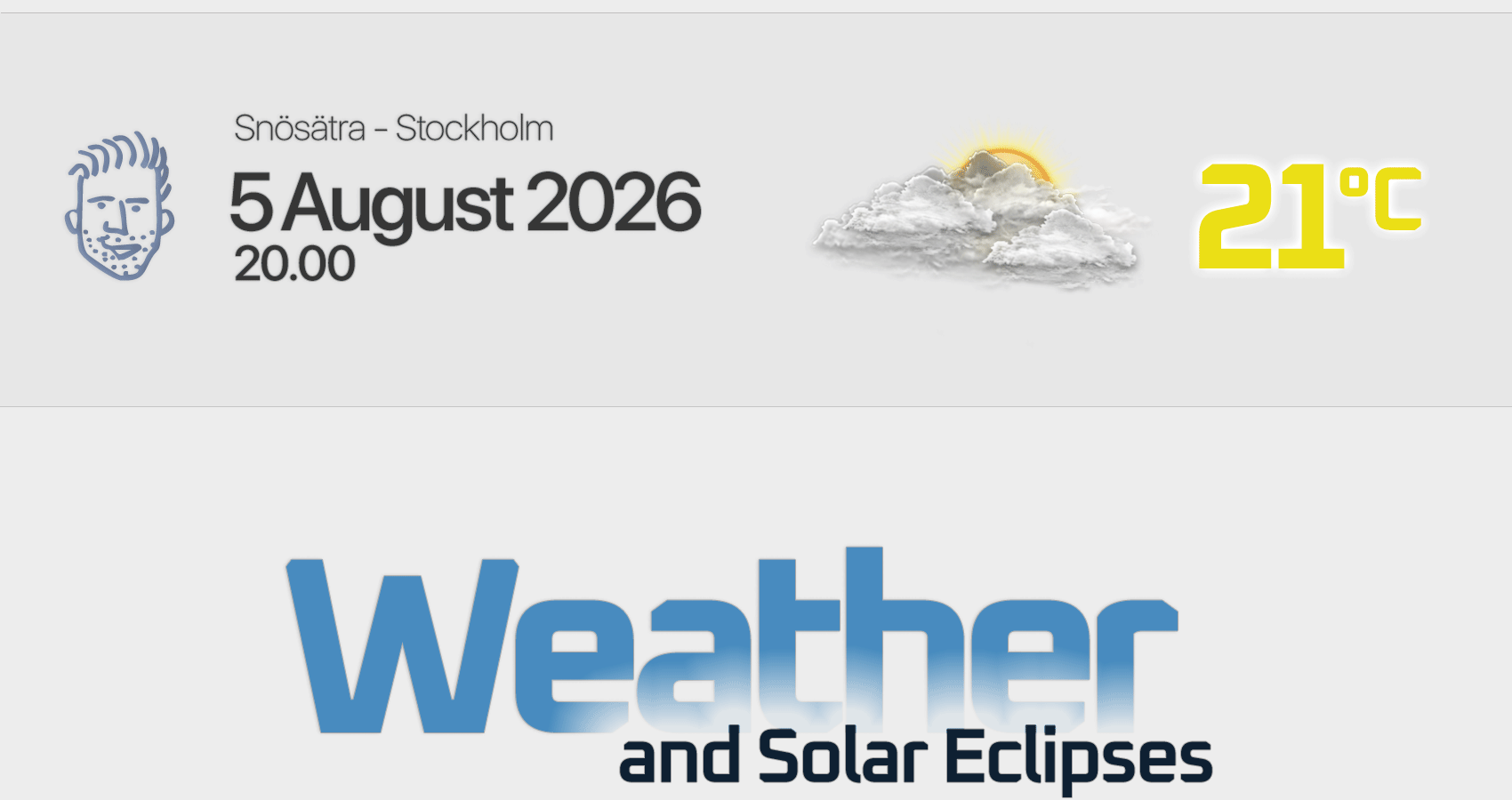
It looks like - according to the weather prognosis, that the 12th of August 2026, will remain cloudless - with of course gives great chances to see the solar eclipse before sunset, up to 85% covered by the moon.
This morning I was seriously contemplating if i should take a flight to Mallorca, in order to see the TOTAL Eclipse there at sunset. (Which makes it extra special... since it is only 3° above horizon at totality). Albeit the distant mountains might interfere with it (?)
Traveling there on a 11th or 12th and then going back on the 13th or 14th (I have five days off around that time). But it costs quite a lot... The ticket price alone isn't all that bad (around 300 €), but the hotels are pretty expensive, especially when you choose two nights, exceeding the price of the ticket. So, the whole adventure would end up with 1000 € for that adventure. So, i have decided against it, given that i would pay it all via an expensive credit card.
Which just isn't smart.
At all.
Smart is however not t always the way we decide on things... right ? 
Various places of Totality
The totality in Palma de Mallorca and its surrounding - will last around 1 minute and 36 minutes. The entire island of Mallorca lies within the path of totality, including all of Menorca as well Ibiza.
In Keflavik (airport), Iceland - totality last 1 minutes 39 minutes - while in Reykjavik the capital of Iceland, just 44 seconds in the eastern suburbs, and 1 minute in the western part / city. Or if you go all the way out to the Ráðagerði Veitingahús, then you get 1 minute and 5 seconds.
The question is the weather there....
In Valencia, Spain - totality lasts 1 minute.
Partial Solar Eclipse (85%), Stockholm (12 Aug)
The eclipse starts around 19.03. Here the sun stands 11.4° above horizon. You NEED a SOLAR FILTER at ALL times in order to observe the eclipse. (Unless it is unusual hazy to such a degree that you can look at the sun. However, that is unlikely - given that we often have very clear air in Sweden)
Around 19.56 - the partial eclipse reaches its largest occultation with around 85% - like an upside down cresent gracing the scene.
At this stage the sun is 4.8° above horizon. Sunset it at 20.46 - and the moon leaves the solar disk a minute later. |