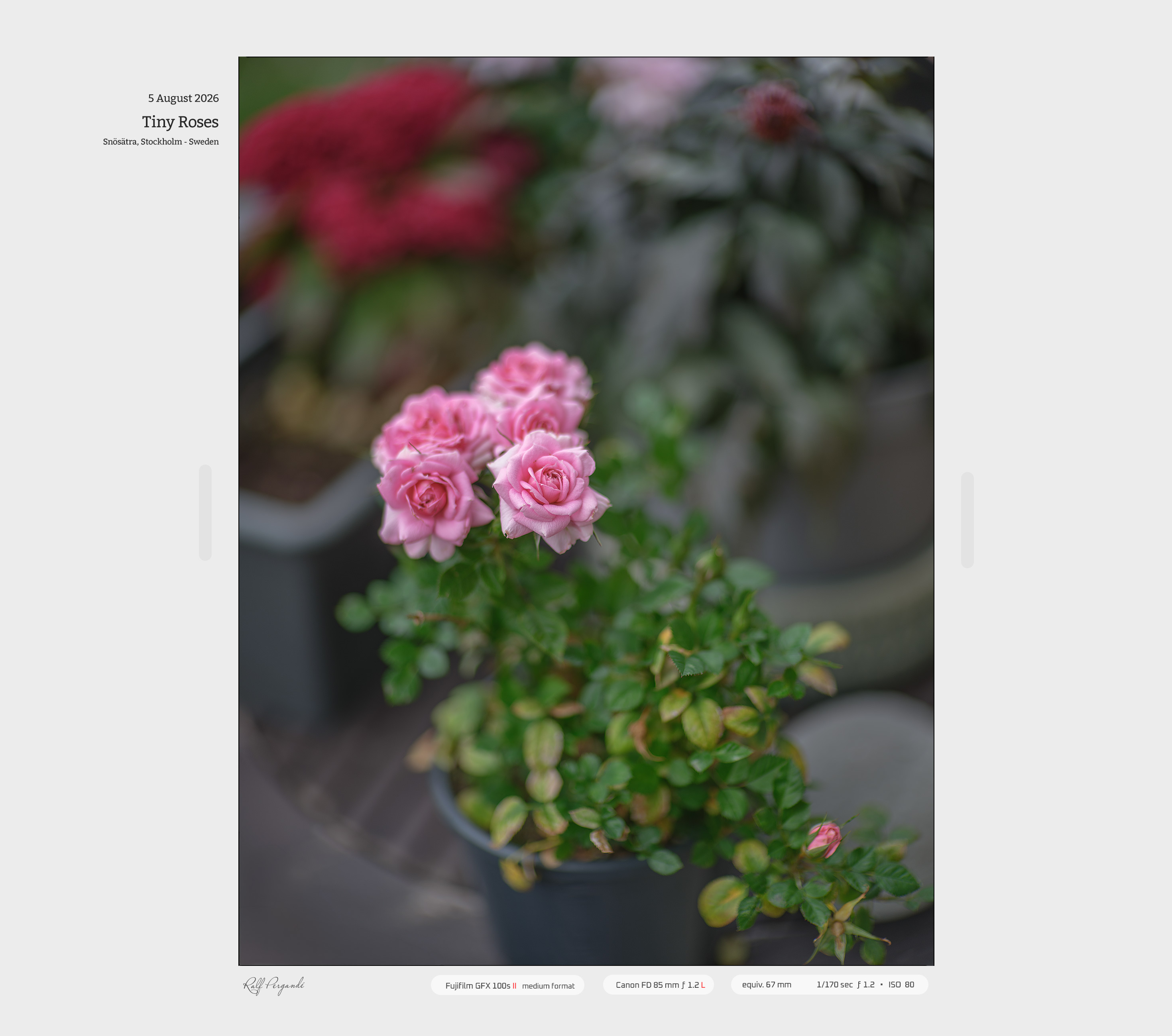
Yeah...
The old Canon FD 85/1.2 L can be very charming - even in the close range if you can set the focus correctly. The rest just floats into that gentle blurriness which made Canon 85/1.2 L lenses so famous. This is one photo where things worked out - even in color - after some correction of the LoCA.
Now that the Samyang XP 85/1.2 is coming in two days - I wonder about the difference in rendering style. Since the Samyang XP is bigger than the old manual FD 85/1.2 L lens, it may or may not compete with my old Canon lens.
We will see.
Sometimes there is a reason to go as "small as possible" - then the Canon FD 85/1.2 L of course wins - because it is rather small compared to modern big guns of similar 85 mm focal length. I think this lens is 72 mm in filter diameter, while the Samyang brings it to an odd 86 mm Ø - and its lens hood is even larger in diameter.
Other times, it might be important that color images don't show a lot of chromatic aberrations - then I would choose the Samyang XP 85/1.2 of course - since it is better. Christopher Frost said about the Samyang XP 85/1.2 that among all the 85mm type of lenses, the Samyang was by far the best of all.
A comment which referred to Christopher Frost's test wrote it this way:
Christopher Frost says it's the sharpest lens he's tested priced under 1000 pounds, better than the Sigma 85 f1.4 Art. However, as already posted, you have to like manual focus. Since Frost said the #2 was the Sigma, that would be my choice as I like auto focus.
Open questions
I also need to know how exactly the Samyang XP 85 performs on the larger Fujifilm GFX sensor. That too is important. Now also let's hope that this second hand lens i bought, is a good copy, without weirdness.
Albeit speaking about weirdness - my old Canon 85L i bought second hand back in 1988 - has plenty of little weirdness. It is prone to flares, to mention one.
A scratch on the back of the lens (which was my fault), and a tiny dot inside of the lens, which originally was a tiny fungus in the 90s, a sort of seed which created fungi around it (the only i ever encountered fungus out of all my 80+ lenses in life). Over time, however, it seem to have died / vanished - because it isn't there anymore, but the damage (whatever it is on the lens element) can still be seen if looked carefully.
In images the dot is gone (when the lens was stopped down to ƒ11) - because the original seed is gone. But you can still see a tiny blob in large bokeh balls, where the seed left tiny amount of damage (or residue) inside/on the glass. It is so small - you would never see or think about it.
So, nothing really to rave about it, either. |