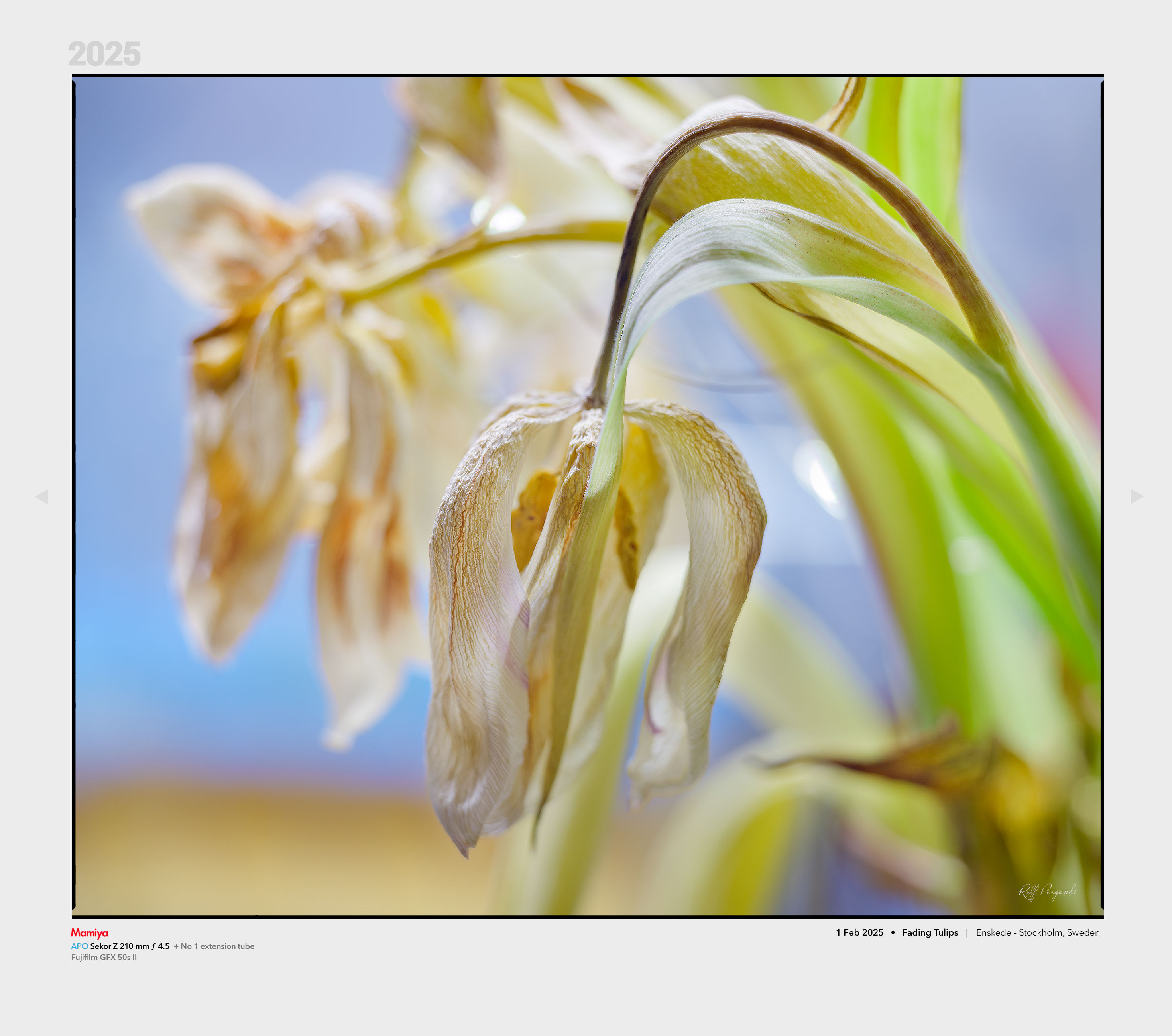
The Mamiya APO 210mm ƒ4.5 works really in a different class; without chromatic aberration, despite being at its minimum focus distance plus having added a No 1 extension tube. Unfortunately i couldn't really get that close. It would require at least a No 2 extension tube, if not more. Not to mention how long the whole shebang would have gotten, weighting down the (hacked) Fotodiox Mamiya-GFX adapter. It would have broken instantly without my hack...
Stellar optical performance, indeed.

So yes, the optical performance is really impressive. The exotic glass really pays off in that regard. Again, I would love to get a bit closer... And I still have to test portrait shots on Sal with the Mamiya RZ67 lenses, including the 210 APO. That should be very interesting.
I am absolutely sure, that the APO 210mm can be used at wide open aperture ƒ4.5 without hesitation. While when stopped down, it is likely too sharp for middle age portraits *LOL*
Still highly affordable
It is fascinating that those lenses are still so affordable on the second hand market (if you find one without mold, separation or haze, I mean). Once upon a time, these APO lenses were truly expensive around 25-30 years ago. Well, you could basically think like this: The special "APO" lenses of today, highly extra corrected ones, or special "digital lenses", (with larger image circle) also cost at least 55.000-67000 SEK / 5000-6000 € - and even more.
Or Phase One lenses to their IQ4 system. Or Leica S lenses where some of them exceed 100.000 SEK / 9000 €. The Mamiya RZ67 Z APO 210 and other ones, where in the same equivalent price class of its time back then, when film ruled the mediumformat world. Everything revolving mediumformat film equipment, was excessive expensive.
And while the APO 210 is absolutely lovely - it isn't that useful for a digital camera.
But not very useful
The issues with adapters, makes Mamiya RZ67 lenses into rather unusable monsters. (Which explains the low prices) They are among the least practically useful lenses on the market. It is that simple. So, the majority of the planet's people, don't use them.
Even if you find a good, useful and stable solution to adapt Mamiya RZ67 lenses to a modern digital camera - you end up with a large configuration, which isn't user friendly. After all - there are plenty of other, smaller lenses you can adapt. Why would one adapt big monsters... Yeah, it makes sense.
I guess people of today want solutions, that you can handhold. Well, few Mamiya RZ67 lenses qualify for it, if at all. I would think only the smaller ones would fit in that description.
While APO 210 lens isn't one of them...
Let's be honest / reasonable in 2025
Many to today's good lenses for 35mm (fullframe, 24x36 image sensor) cameras, do better jobs, are way easier to handle, have plenty of millions of pixels, are extremely flexible in terms of how you can utilize them together with the camera's digital software. I mean, AF, speed, focus bracketing and all those modern things in photography. They are way smaller (often but not always), relatively affordable - and overall simply far more user friendly. Why would somebody deal with Mamiya RZ67 lenses in year 2025 ? Doesn't make sense.
Mediumformat, Fujifilm GFX
And if you talk about Mediumformat cameras like the Fujifilm GFX system - well using Fujifilm's native GF lenses does make a lot of sense. They are the best for the GFX system. Basta ! They are streamlined, give largest bang for the buck per pixels, in terms of optical quality and user friendliness. They are, while still expensive, at the same time way more affordable compared to other system systems like Leica, Hasselblad, Phase One, and so on.
Giving them love
In my case, I have decided to give the Mamiya RZ67 lens lots and lots of love
*LOL*
I love those clumsy, heavy, bulky, chunky, stealth lenses. It is strange, but i really like using them. For a very long time, they were just collecting dust, shuffled away in a box "for ewwa", rarely used during the past 25 years.
Well, i love the whole RZ67 system, and most likely my "affection" is based on that I lived so long with the Mamiya RZ67 camera system starting in 1987. I was 21 and dared to buy that thing on credit. Which made me very uncomfortable, I remember. As if i did something forbidden - taking a credit just for a mediumformat camera I knew nothing about (in practice). Surely i did study it during many months before i decided to buy one. in 1987, I didn't even have a darkroom yet. So, a part of me felt as if i was walking into a gamble... unsure what to expect. Unsure if i would like it enough, in order to work with it many years ahead.
Oh, and I did. For almost 40 years - and the Mamiya RZ67 Pro always delivered !
It still does ! |